Skip to content

Exercise technique guide

How to Do a Plank

The plank has you hold a straight-body position on your forearms and toes. It trains the whole core to keep your spine stable, which protects your back and improves every other lift. It needs no equipment and scales easily for any level.
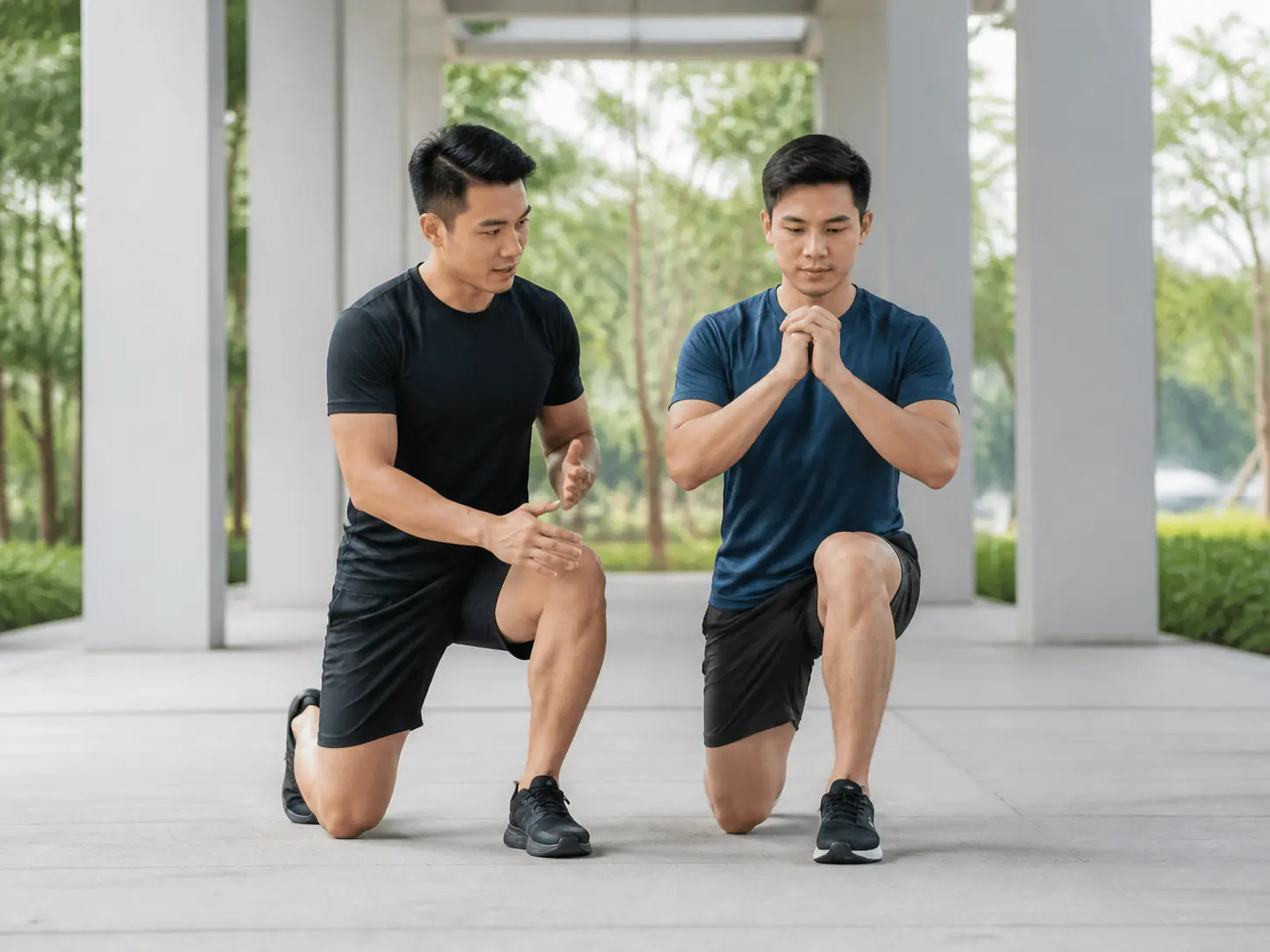
A trainer demonstrating controlled split-squat technique

The plank teaches your core to do its real job: keeping your spine solid while everything else moves. That stability protects your back when you lift, carry, or twist, which is why it earns a place in almost every program we write.

You need nothing but a bit of floor, so it fits a bedroom or our Putra Heights centre. Done well it is deceptively hard, and holding good form for thirty honest seconds beats a sloppy two minutes every time.

What it trains and who it suits

It trains the deep core, abs and glutes to resist your spine sagging. It suits everyone, from beginners building core control to lifters wanting a more stable base.

Because it is a hold with no impact, it is low-risk and easy to scale, making it a safe starting point for people with back concerns who have been cleared to train.

Step-by-step cues

  1. Set your forearms on the floor under your shoulders
  2. Extend your legs back with toes tucked under
  3. Form a straight line from head to heels
  4. Squeeze your glutes and brace your stomach hard
  5. Hold, breathing steadily, without letting the hips sag

Common mistakes and quick fixes

  • Hips sagging, squeeze the glutes and tuck the ribs down
  • Hips piking up, lower them into a straight line
  • Holding the breath, breathe steadily throughout
  • Neck craning up, look at the floor to keep it neutral

Regressions, progressions and when to stop

Too hard? Plank from your knees or with hands on a bench. Too easy? Hold longer, lift one foot, or add a reach. At home the floor is all you need; at our centre we add loaded and moving plank variations.

  • Stop if you feel sharp low-back pain rather than core effort
  • See a professional if planks always trigger back pain

Frequently Asked Questions

How long should I hold a plank?+

Quality beats duration. Two or three holds of twenty to forty seconds with perfect form is plenty. Once that is easy, progress to harder variations rather than very long holds.

Why do I feel planks in my lower back?+

Usually the hips are sagging. Squeeze your glutes, tuck your ribs down, and brace your stomach so the core, not the back, does the work.

Are planks better than sit-ups?+

For Many people, yes. Planks train the core to stabilise the spine, which carries over to real life and lifting, without the repeated spinal flexion of sit-ups.

Can I do planks with a bad back?+

Often they help, but only if pain-free and cleared. Start from the knees or a bench, keep it short and braced, and see a professional for ongoing back pain.

Continue exploring

Programmes

Functional Fitness

Functional fitness trains your body for the things you actually do, carrying shopping up to the condo, picking a child off the floor, twisting to reach the back seat. We build strength, stability and mobility in real movement patterns, not isolated machine work, so daily life gets easier.

See what it includes →
Personal Training

Partner 2-to-1 Training

Partner 2-to-1 training pairs you with someone you know, a spouse, sibling or friend, under one trainer for the session. You split the cost, keep each other accountable, and still get real coaching, with the trainer adjusting each person's weights and exercises to their level.

Compare this option →
Programmes

Core Training

Core training builds the deep trunk muscles that stabilise your spine, protect your back and transfer force between your upper and lower body. It is about a strong, functional midsection that supports everything you do, not just chasing visible abs with endless crunches.

See what it includes →
Goals

Train Consistently

Training consistently is the goal that makes every other goal possible, nothing works if you keep quitting. We build consistency with a realistic plan, booked sessions, honest accountability and a strategy for busy weeks, so momentum survives real life instead of collapsing.

See the coaching approach →
Weight Loss

Build Muscle While Losing Fat

Building muscle while losing fat is possible if you get three things right: eat enough protein, train strength progressively, and keep the calorie deficit modest. It works best for beginners and returners, is slower than one goal alone, and needs measuring beyond the scale.

See the coaching approach →
Weight Loss

Strength Plus Cardio for Fat Loss

The best fat-loss plans use both strength and cardio, not one or the other. Strength keeps muscle and shape; cardio and walking add extra calorie burn and heart health. We show you how to combine them without overtraining, so fat drops while your body stays strong.

See the coaching approach →

Want help applying this guide to your own training?

Private coaching adapts exercise choice, loading and progression to your level, equipment and goal.

Ask a question first Request an assessment time