Skip to content

Exercise suitability guide

Exercise With Stable Chronic Conditions in KL & Selangor

If you live with a stable long-term condition and your doctor has cleared you, exercise can be adapted to fit your body, limits and energy. We coach flexibly, respect the guidance your doctor gave, and refer you back if anything changes. We coach fitness only; managing the condition stays with your doctor.
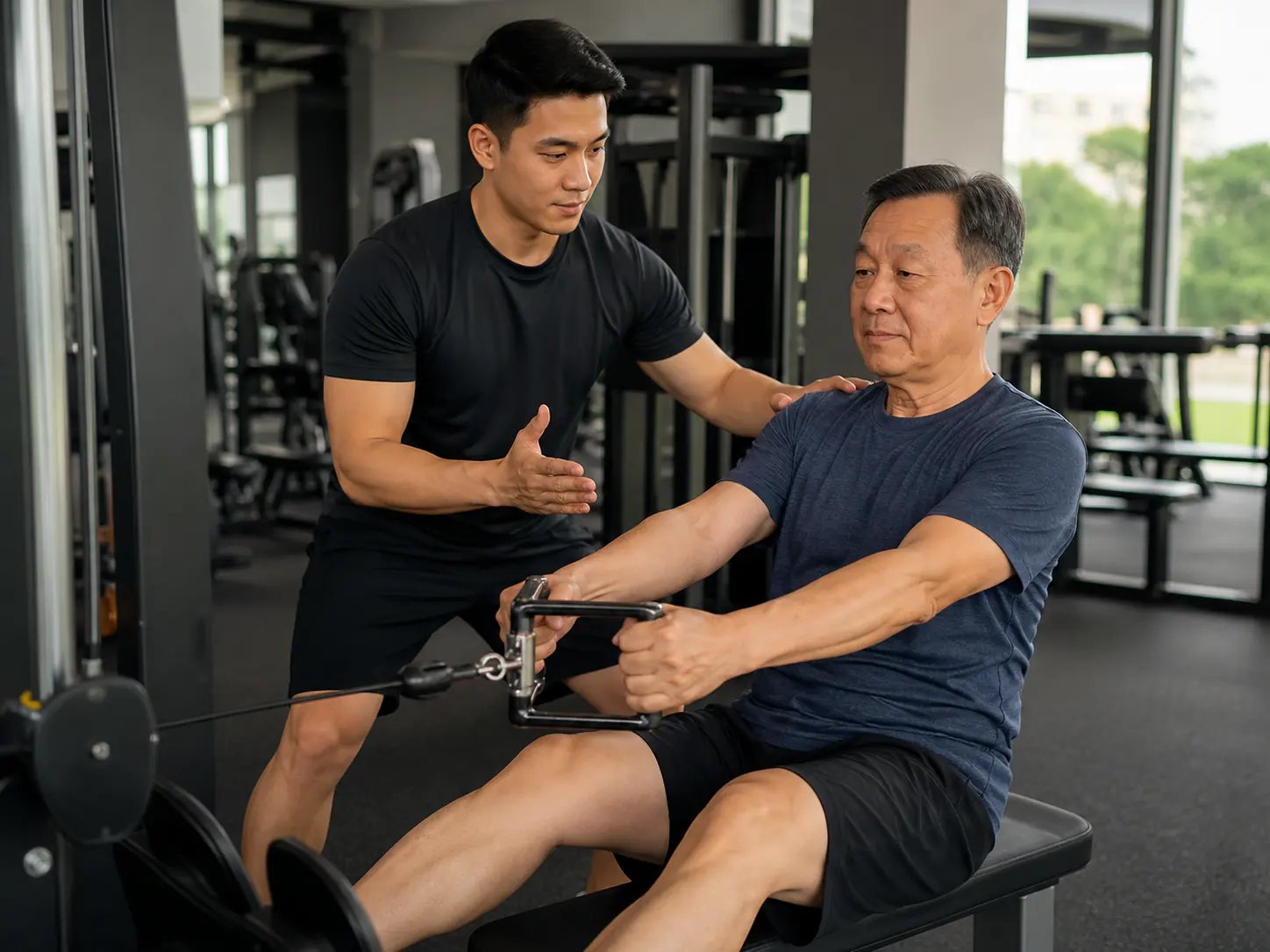
An older adult completing a supervised cable-row exercise

Living with a long-term condition does not mean sitting on the sidelines. When things are stable and your doctor has cleared you, sensible exercise can be adapted to almost anyone, the plan simply has to respect your particular limits, your energy patterns, and the guidance your medical team has given, rather than following a one-size-fits-all template.

We coach fitness, and we stay firmly in that lane. We do not diagnose, treat or manage your condition, and we make no claims about changing it, all of that belongs to your doctor. What we offer is flexible, attentive coaching that adapts to good days and harder days, and the good sense to refer you back the moment something shifts.

Adapting training to your condition

Every plan starts from your reality: what you can do comfortably, what your doctor has flagged, and how your energy tends to move through a week. We build flexibility in, so a harder day means we adjust rather than cancel, and a good day never becomes an excuse to overdo it.

We keep close track of how you respond and stay in easy communication, so the plan evolves with you. Stable does not mean static, and we would always rather adapt early than push through something that does not feel right.

How we coach around a long-term condition

  • Build the plan around your specific limits and energy
  • Follow whatever guidance your doctor has given us
  • Adapt intensity to good days and harder days
  • Keep communication open so we can adjust quickly
  • Refer you back to your doctor the moment things change

Red flags, stop and get review

  • Any worsening or flare-up of your condition's symptoms
  • New or unusual symptoms you have not had before
  • Chest pain, breathlessness, dizziness or fainting
  • Fatigue or symptoms that linger long after a session
  • Anything your doctor told you to watch for, contact them promptly

Your doctor manages the condition

Diagnosing, monitoring, medicating and managing your long-term condition is entirely your doctor's role, and we never step into it. We coach exercise around a stable picture, following their guidance. If your condition changes, your medication changes, or new symptoms appear, we pause and send you back to them.

Frequently Asked Questions

Can I exercise with a long-term health condition?+

Often yes, when it is stable and your doctor has cleared you. We adapt training to your limits, energy and any guidance they gave. We coach fitness only and refer you back if anything about your condition changes.

What if my energy varies day to day?+

That is exactly why we build flexibility in. On harder days we adjust intensity or focus rather than cancelling; on good days we avoid overdoing it. Training with a condition means working with your energy, not against it.

Do you need to know my medical details?+

We ask about your condition, any limits your doctor set, and what to watch for, so we can train you safely. We do not manage or treat it, we simply coach within the boundaries your doctor has given.

What happens if my condition flares up?+

We stop, ease back, and if it is significant we refer you to your doctor before continuing. We never train through a flare-up. Managing the condition is theirs; keeping your training safe around it is ours.

Continue exploring

Assessments

Your Health History

Your health history is the record of past injuries, conditions, surgeries and medications you share before training. It is not judged or diagnosed, it is used to set safe loads, train around old problems, and know when to refer you to a doctor first. The fuller it is, the safer you train.

See how it works →
Assessments

Fitness vs Clinical Assessment

A fitness assessment sets a safe starting point for training, mapping strength, stamina and movement. A clinical assessment diagnoses injuries and medical conditions, and only qualified healthcare professionals do that. We do the first, never the second, and refer you on the moment something needs a doctor or physio.

See how it works →
Why KinesioFitness

Safety & Screening

Before you lift anything heavy, we screen you: a health-history questionnaire, a movement check, and a look at any conditions or medications that affect training. If we spot a red flag, we get you cleared by a doctor first. Good screening is why serious injuries in our sessions are so rare.

Compare this option →
Why KinesioFitness

Results You Can Expect

Realistically, you can expect rising strength within weeks, better energy and sleep early, and visible body changes over a couple of months of consistency. We do not promise dramatic 30-day transformations. We promise steady, honest progress that lasts, which is what actually changes your life.

Compare this option →
Exercise Library

Inverted Row

The inverted row has you pull your chest to a fixed bar while your body stays straight and your feet stay on the floor. It is a beginner-friendly bodyweight pull that builds back and grip strength, and its difficulty scales just by changing your body angle.

Learn the technique →
Exercise Library

Plank

The plank has you hold a straight-body position on your forearms and toes. It trains the whole core to keep your spine stable, which protects your back and improves every other lift. It needs no equipment and scales easily for any level.

Learn the technique →

Not sure whether exercise is suitable for your situation?

Share your situation, any medical clearance and your training goal. We will explain the fitness scope and when referral is needed.

Ask about exercise suitability Request an assessment time