Skip to content

Exercise suitability guide

Low-Impact Training Options for Sensitive Joints in KL & Selangor

If your joints are sensitive and your doctor has cleared you, low-impact training builds strength and fitness without the jarring that aggravates sore knees, hips or backs. We coach controlled, joint-friendly options and adjust to how you feel. This is general fitness coaching, not treatment for a joint problem.
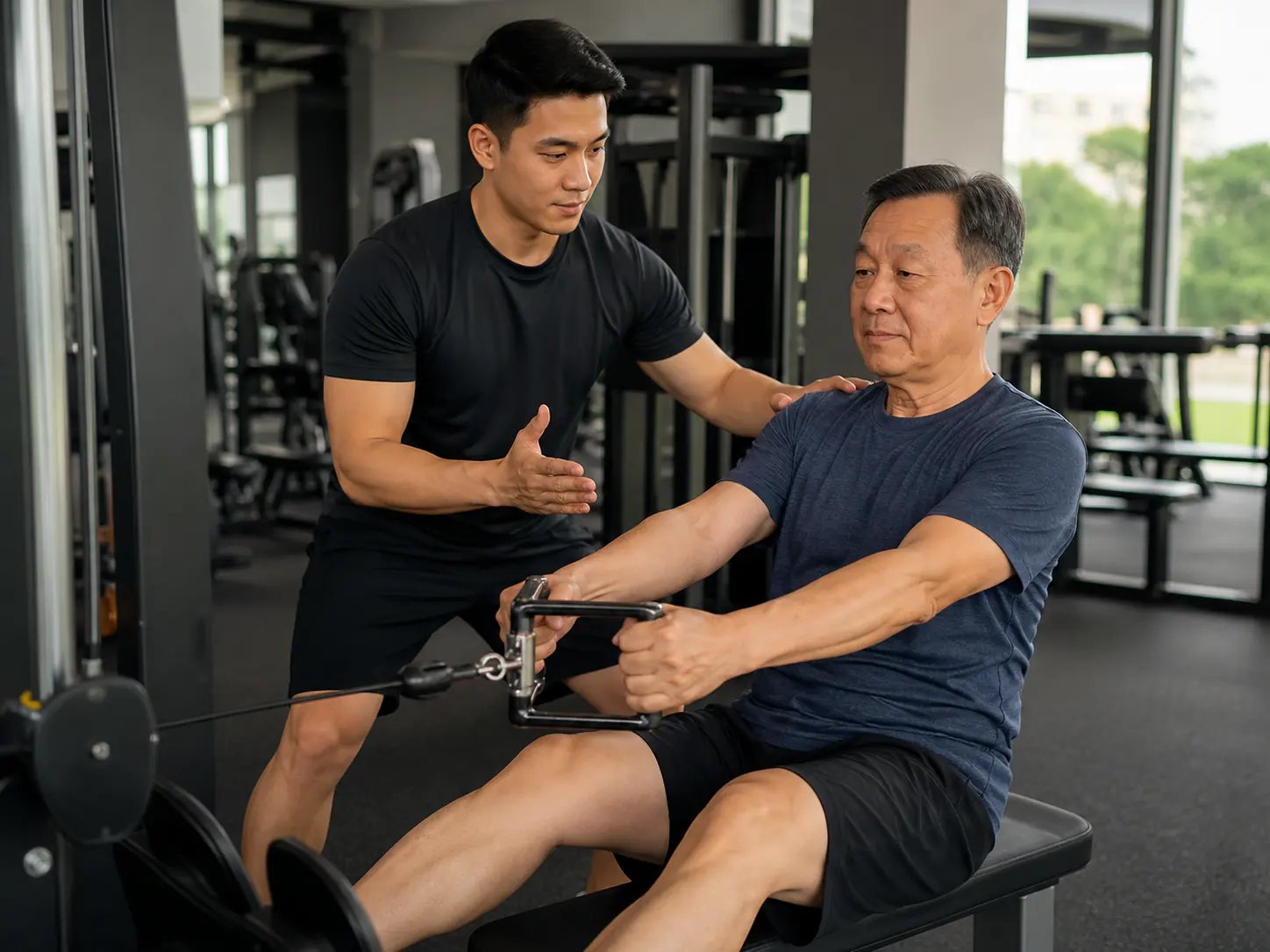
An older adult completing a supervised cable-row exercise

A lot of people assume getting fit means running and jumping, and if their knees or hips already complain, they conclude exercise is not for them. It is a false choice. Low-impact training builds real strength and stamina without the repeated pounding, so sensitive joints are a reason to train smarter, not a reason to stop.

This is general fitness coaching for cleared clients, not treatment for a joint problem. If a joint is injured, undiagnosed, or your doctor has not cleared you, that needs sorting first. Once you are good to go, we choose controlled, joint-friendly movements and adjust the plan to how your joints feel day to day.

What low-impact training looks like

Low-impact does not mean low-effort. Cycling, swimming, the rower, controlled strength work and supported movements can all build serious fitness while keeping both feet, or your body weight, from hammering the joint. We choose the options that suit your body and the equipment you have, whether at our centre, home or a condo gym.

Strength work is a big part of it, because stronger muscles around a joint tend to make everyday movement feel easier and more supported. We keep everything controlled and comfortable, avoiding the jarring end-ranges that tend to flare sensitive joints.

Joint-friendly options we use

  • Cycling and swimming for cardio without pounding
  • Rowing and cross-trainer work where they suit you
  • Controlled strength work in comfortable ranges
  • Supported and seated movements when helpful
  • Balance and mobility work to keep joints moving well

Red flags, stop and get review

  • Sharp joint pain during a movement, rather than mild effort
  • A joint that swells, feels hot, or looks red after training
  • A joint that locks, catches or gives way
  • Pain that lingers badly for days after a session
  • A new or undiagnosed joint problem, get it checked before continuing

When a joint needs a professional first

Low-impact coaching is for cleared clients with sensitive but stable joints, not for treating an injury. If a joint is newly painful, swollen, unstable, or undiagnosed, that is a job for your doctor or physio first. We coach general fitness around a joint once it is cleared, and refer back if anything changes.

Frequently Asked Questions

Can I get fit without running or jumping?+

Absolutely. Cycling, swimming, rowing and controlled strength work build real fitness with far less impact on your joints. Sensitive joints are a reason to train smarter, not a reason to give up on getting fitter.

Will strength training hurt my sore joints?+

Done in controlled, comfortable ranges, strength work generally supports the joint by building the muscle around it. We avoid jarring positions and swap anything that causes sharp pain. You set the limits and we listen.

Is this treatment for my joint problem?+

No. This is general fitness coaching for cleared clients, not treatment. If a joint is injured, undiagnosed or not cleared, see your doctor or physio first. Once cleared, we coach low-impact fitness around it.

What if my joints feel worse on some days?+

We adjust. On flarier days we go lighter, lower-impact, or focus on mobility. Training with sensitive joints means responding to how they feel that day rather than forcing a fixed plan.

Continue exploring

Assessments

Mobility Assessment

A mobility assessment looks at how freely your joints move, hips, shoulders, ankles, spine. It is not a diagnosis of a problem; it shows us which ranges are safe to load and which to open up gradually. For desk-bound Klang Valley bodies, it usually explains a lot about why certain movements feel tight.

See how it works →
Assessments

How Often to Reassess

Most fitness markers are best reassessed every four to six weeks. That is long enough for training to produce real change, but frequent enough to keep your plan accurate and your motivation high. We reassess sooner if something changes health-wise, and we always refer to a doctor when needed.

See how it works →
Why KinesioFitness

Our Approach to Beginners

Complete beginners are who we love working with most. No experience needed, we teach the basics from scratch, keep every session judgement-free, and progress slowly enough that you build confidence, not injuries. If you have never lifted a weight in your life, you are exactly who this is for.

Compare this option →
Why KinesioFitness

Privacy & Discretion

Many people avoid gyms because they feel watched. We fix that. Sessions are private 1-to-1, your health information and progress photos stay confidential, and nothing is ever shared or posted without your written consent. For a lot of clients, that discretion is the whole reason they finally started.

Compare this option →
Personal Training

Small-Space Home Training

You do not need a spare room or a home gym to train properly. A two-by-two-metre patch of floor, minimal equipment and a good plan are enough for a real strength session. Small-space training is designed around compact, quiet, effective movements that fit a KL apartment.

Compare this option →
Exercise Library

Band Pull-Apart

The band pull-apart has you stretch a resistance band across your chest by squeezing your shoulder blades. It strengthens the upper back and rear shoulders, muscles that improve posture and shoulder health. It is simple, low-risk, and perfect between other exercises.

Learn the technique →

Not sure whether exercise is suitable for your situation?

Share your situation, any medical clearance and your training goal. We will explain the fitness scope and when referral is needed.

Ask about exercise suitability Request an assessment time