Skip to content

A progressive strength programme

Build strength with a plan that shows you what to progress next

Learn a small set of useful movement patterns, establish suitable starting loads and follow a programme that changes only when technique, performance and recovery support the next step.
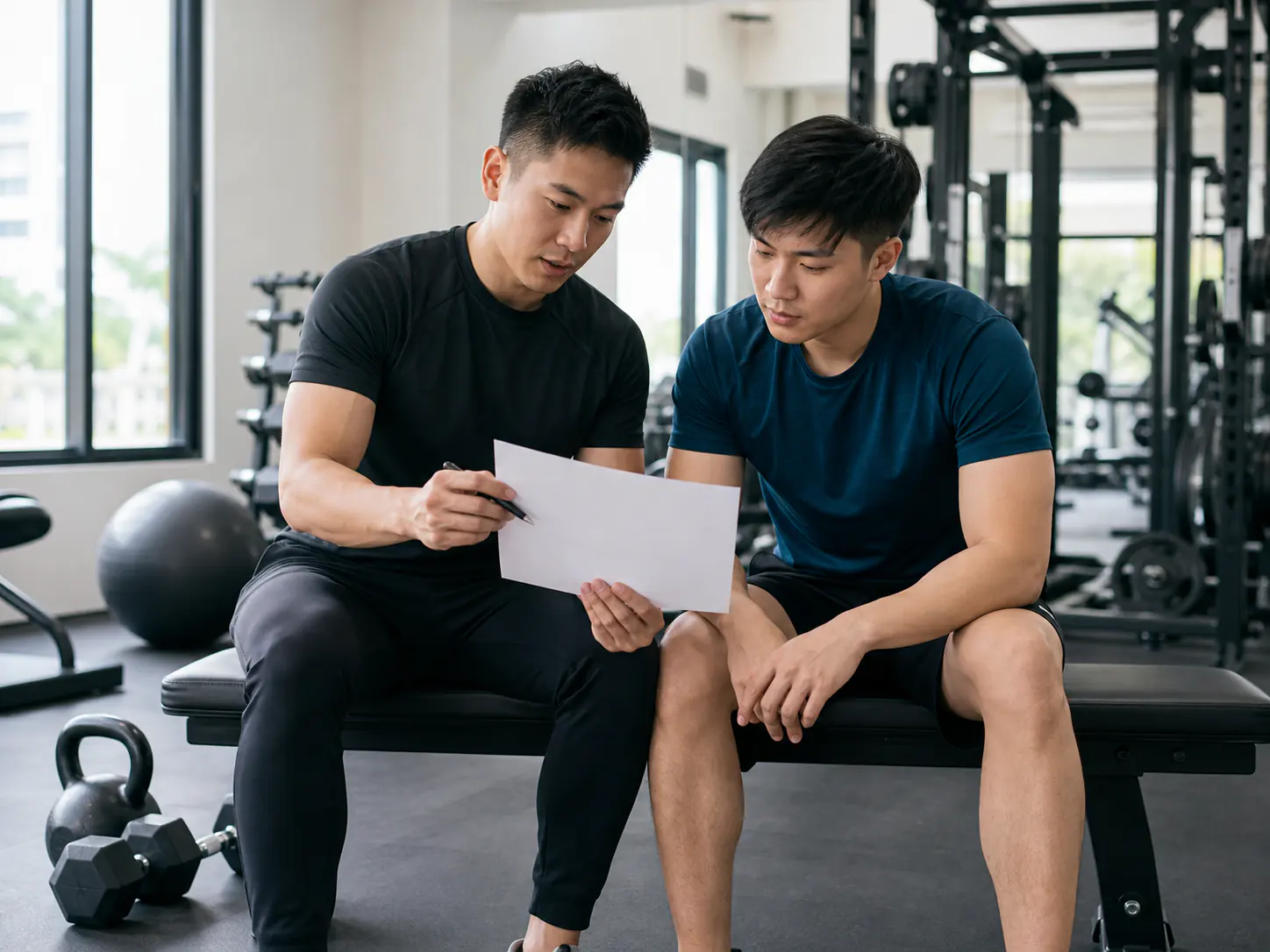
A trainer and client reviewing a structured training programme

Strength training works best when the programme repeats important movements long enough for you to learn them and improve them. Constantly changing exercises may feel varied, but it makes technique and progress harder to measure.

We choose variations that suit your current mobility, experience, equipment and confidence. As your movement becomes more consistent, the programme can progress load, repetitions, range of motion or exercise difficulty without rushing the process.

The movement patterns the programme develops

  • Squat and step patterns for legs, knees and everyday rising
  • Hinge patterns for hips, posterior strength and lifting from the floor
  • Push and pull patterns for upper-body strength and shoulder control
  • Carries and core work for grip, trunk control and whole-body stability

How progression is decided

Progress is not limited to adding the largest possible weight. A session may progress through cleaner technique, more controlled range, an extra repetition, a small load increase or a harder variation. The coach selects the change that preserves the purpose of the exercise.

What a typical training week may look like

  1. Two or three full-body sessions built around the main patterns
  2. A consistent warm-up that prepares the movements used that day
  3. Primary strength work followed by supporting exercises
  4. Simple mobility, walking or independent work between coached sessions
  5. Regular review of recorded loads, repetitions and recovery

Equipment and training location

The Putra Heights centre supports heavier barbell and rack-based progress. Home and condo-gym programmes can still develop strength using dumbbells, cables, bands, bodyweight and unilateral exercises. We explain when equipment is a genuine limitation and when a different exercise solves it.

Frequently Asked Questions

Do I need lifting experience?+

No. Beginners can start with supported or lighter variations and learn one pattern at a time. The assessment helps decide which movements are appropriate first.

Will strength training make me bulky?+

Strength training can improve muscle and body composition, but large muscle gain requires sustained training, nutrition and time. The programme is adjusted to your goal, not built around a bodybuilding assumption.

How quickly should the weights increase?+

There is no fixed weekly increase for everyone. We progress when technique, repetitions and recovery show that the current level is manageable.

Can strength training be done at home?+

Yes. Many goals can progress with dumbbells, bands and bodyweight. If your future target requires heavier equipment, selected centre sessions can be added.

Continue exploring

Goals

Get Stronger

Getting stronger means lifting more weight on the movements that matter, squat, hinge, press, pull and carry, through a planned progression. We coach technique first, then add load week by week 1-to-1 so the numbers climb safely and your daily life gets easier.

See the coaching approach →
Assessments

Push-Up Test

A push-up test counts how many good-form push-ups you can do in a row to gauge upper-body strength and endurance. We scale it, wall, incline, knees or full, to your level. It is a fitness marker we improve over time, done with quality reps, not a max-out competition or a medical test.

See how it works →
Goals

Build Muscle

Building muscle means adding lean tissue through progressive strength training and eating slightly more, especially protein. We coach the lifts, load them up over time, and track your numbers 1-to-1 so you gain size and strength without wasted months guessing in the gym.

See the coaching approach →
Personal Training

Condo Gym Personal Trainer

Condo-gym coaching uses the facility already in your building and turns its available dumbbells, cables, benches and cardio equipment into a structured programme. The trainer checks access and equipment first, then plans sessions that can progress without requiring another gym membership.

Compare this option →
Personal Training

Home Personal Trainer

A home personal trainer brings the coaching to you and adapts the session to your available space, equipment and household routine. It suits people who value privacy, have limited travel time or find that removing the commute makes regular training easier to maintain.

Compare this option →
Who We Help

Personal Training for Adults Over 50

Personal training after 50 can focus on strength, balance, bone-loading exercise, mobility and the everyday tasks you want to keep doing independently. Screening and progression are adapted to health history, medication, symptoms, current capacity and medical guidance where relevant.

See how coaching adapts →

Ready for a more structured way to train?

Start with an assessment so we understand your level, goal, schedule and preferred training location.

The request opens WhatsApp; a time is confirmed only after we reply and agree it with you.

Request an assessment time Ask a question first