Skip to content

Practical fitness guide

Goal Setting That Actually Works for Training

Good goals are specific, measurable and mostly about what you do, not just the outcome. Instead of chasing a number on the scale, you build goals around actions you control, sessions attended, weights lifted, habits kept. Those process goals are what quietly deliver the results everyone else only wishes for.
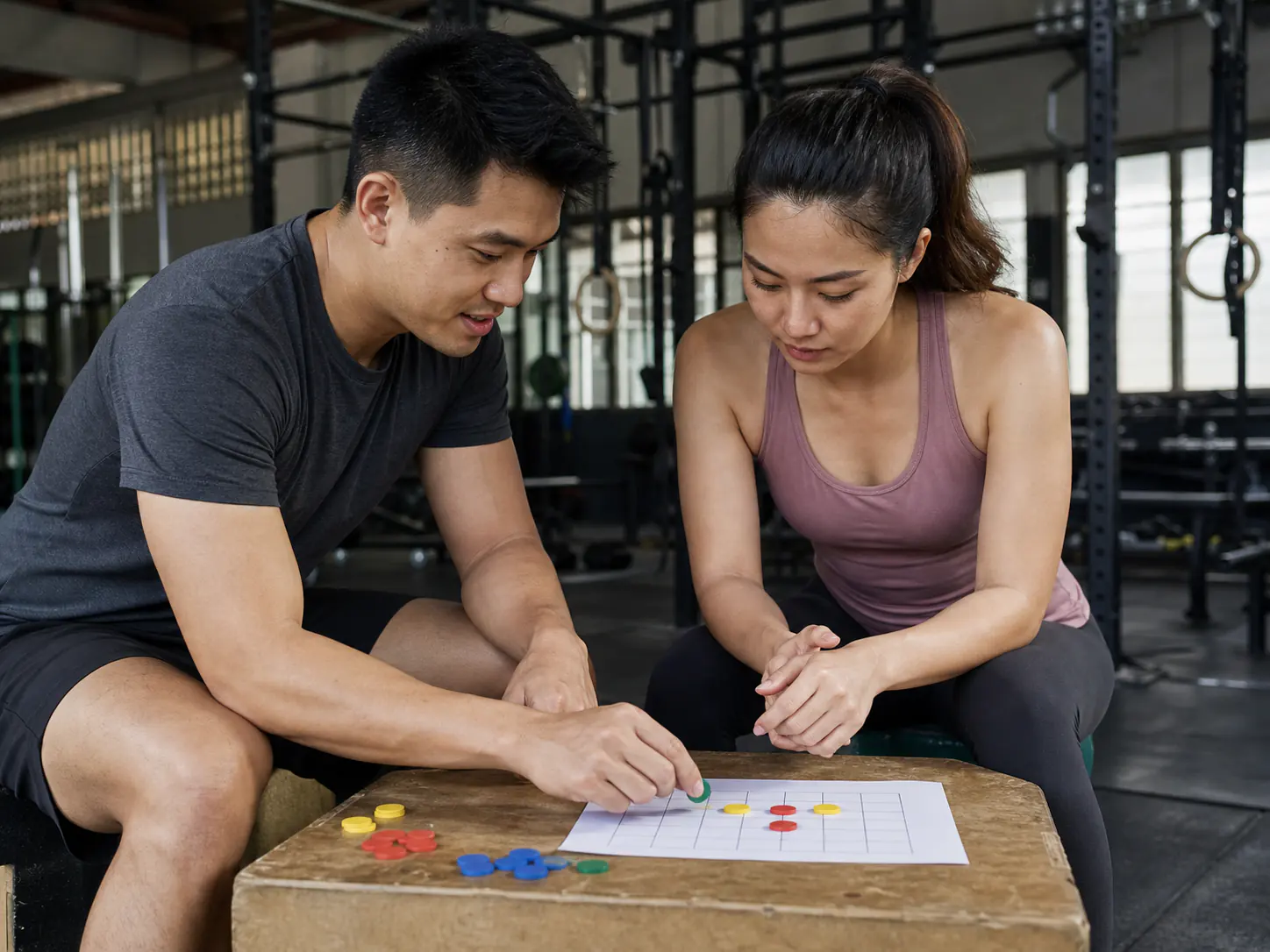
A trainer and client reviewing training progress between sets

Many people set fitness goals the same way and fail the same way. The goal is vague, get fit, lose weight, tone up, and pinned entirely to an outcome they cannot directly control. When the scale does not move fast enough, motivation collapses and the whole thing quietly ends by February.

Better goals work differently. They are specific, they are measurable, and crucially they focus on the actions you take rather than only the result you want. Show up twice a week, add weight to your squat, hit your protein most days, do those, and the outcome takes care of itself. This page shows how we set goals clients actually keep.

Why most goals fail

Vague goals give you nothing to act on. Lose weight is a wish, not a plan. And when a goal lives entirely in the outcome, every slow week feels like failure, even when you are doing everything right.

Outcomes also lag behind effort. You can train perfectly for a fortnight and the scale barely moves, because bodies do not change on a neat schedule. Goals built only on outcomes set you up to feel like you are losing when you are actually winning.

Process goals beat outcome goals

  • Outcome goal: lose 5kg. Process goal: train twice weekly and hit protein
  • You control actions; you only influence outcomes
  • Process goals give a daily win, not a distant maybe
  • Hit the actions consistently and outcomes follow

How to set a goal that sticks

Make it specific and measurable, with a clear action attached. Not get stronger but add 10kg to my squat over three months by training twice a week. Now you know exactly what to do tomorrow.

Anchor it to your real life. A goal that ignores your KL work hours, your family and Ramadan will break. We set targets that survive a bad week, because a goal you can keep through the hard stretches is the only kind that works.

Our goal-setting process

  1. Define the outcome you truly want, honestly
  2. Translate it into weekly actions you control
  3. Set a realistic timeline with room for life
  4. Review monthly and adjust rather than abandon

Frequently Asked Questions

Why do my fitness goals never last?+

Usually because they are vague and tied only to an outcome like the scale. When results lag, motivation dies. Goals built around specific weekly actions you control are far easier to keep and quietly deliver the outcome.

What is a process goal?+

It is a goal about what you do rather than the result, like training twice a week or hitting your protein most days. You fully control these, so they give reliable wins that add up to the outcome you want.

Should I set a goal weight?+

A target can help as a direction, but do not let it be the only measure. Pair it with process goals and other markers like strength and how clothes fit, so slow scale weeks do not derail you.

How do I stay motivated toward a long goal?+

Break it into weekly actions that give frequent small wins, and track them. Seeing a run of completed sessions builds momentum far better than staring at a distant target that moves slowly.

Continue exploring

Why KinesioFitness

Our Approach to Beginners

Complete beginners are who we love working with most. No experience needed, we teach the basics from scratch, keep every session judgement-free, and progress slowly enough that you build confidence, not injuries. If you have never lifted a weight in your life, you are exactly who this is for.

Compare this option →
Personal Training

Small-Space Home Training

You do not need a spare room or a home gym to train properly. A two-by-two-metre patch of floor, minimal equipment and a good plan are enough for a real strength session. Small-space training is designed around compact, quiet, effective movements that fit a KL apartment.

Compare this option →
Goals

Flexibility for Desk Workers

Flexibility for desk workers targets the specific tightness that eight hours in a chair creates, locked-up hips, short hamstrings, a stiff neck and tight chest. We coach a practical routine 1-to-1, plus desk-break habits, so you feel loose and comfortable instead of permanently seized up.

See the coaching approach →
Goals

Sustainable Weight Loss

Sustainable weight loss means losing weight at a pace you can hold and keeping it off for years, not weeks. We skip crash diets and build habits, steady eating, regular strength work and daily movement, coached 1-to-1 so the plan survives real life, festivals and travel.

See the coaching approach →
Personal Training

Mobile Personal Trainer

A mobile personal trainer is not tied to one venue, the coaching travels to wherever works for you that week: home, condo gym, a nearby park, or our centre. One plan follows you across settings, so a busy or changing schedule never breaks your training.

Compare this option →
Why KinesioFitness

Why 1-to-1 Beats Group

In a group class the coach splits attention across a room and the workout is one-size-fits-all. In 1-to-1 training, every minute, every cue and the entire plan is built around you. That is why 1-to-1 produces faster, safer results, especially for beginners and anyone with a niggle.

Compare this option →

Want help applying this guide to your own training?

Private coaching adapts exercise choice, loading and progression to your level, equipment and goal.

Ask a question first Request an assessment time