Your first step
Mobility Assessment: How Well You Move
A mobility assessment looks at how freely your joints move, hips, shoulders, ankles, spine. It is not a diagnosis of a problem; it shows us which ranges are safe to load and which to open up gradually. For desk-bound Klang Valley bodies, it usually explains a lot about why certain movements feel tight.
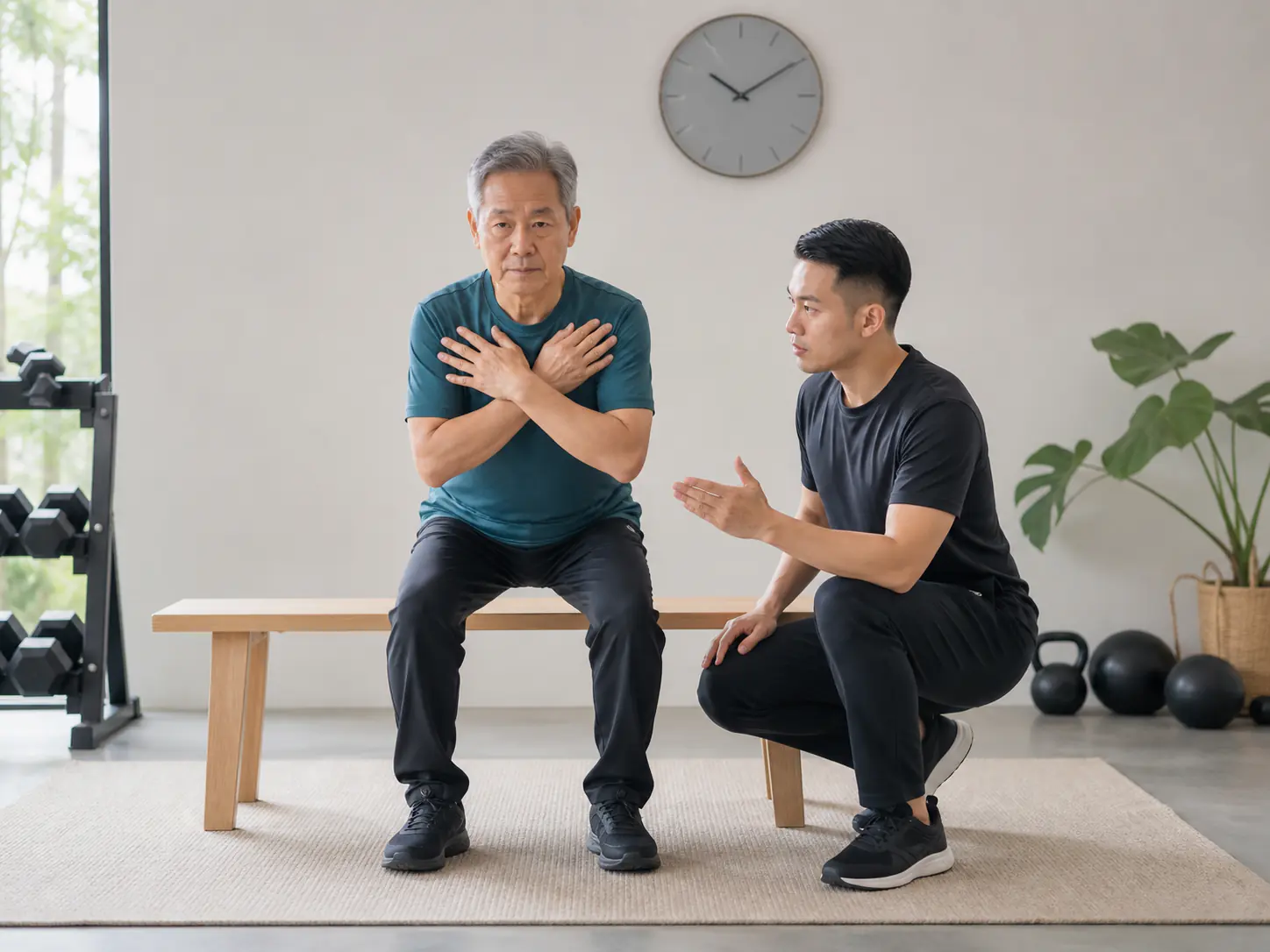
Years at a desk in KL traffic and a laptop leave Many people stiff in predictable places, hips, upper back, shoulders and ankles. A mobility assessment simply shows where your range is limited today so we do not force a squat or overhead press into a range your joints cannot yet reach comfortably.
This is about safe training, not fixing you. If a joint is stiff but healthy, we train the range you have and widen it over time. If something is stiff and painful, or locks and clicks in a way that worries us, that is where we suggest a physio takes a look before we load it hard.
The joints we usually check
- Ankles, how deep you can squat without heels lifting
- Hips, depth and comfort in a squat and hinge
- Shoulders, reaching overhead without arching the back
- Upper back, rotation and extension for pressing
- Neck, comfortable range for loaded positions
How mobility shapes your plan
If your ankles are stiff, we might raise your heels or choose a squat variation that fits your range while we work on opening the ankle. If your shoulders will not go fully overhead yet, we press at an angle you can control. Nothing is forced; the plan meets your range where it is today.
Over the weeks, mobility drills go into your warm-ups and slowly widen those ranges. Most desk-bound clients see meaningful change here within a month or two of consistent work.
How the mobility check runs
- You move through a few standard positions, squat, reach, hinge
- We watch where the range stops and whether it is stiffness or pain
- We note left-right differences and any compensations
- We pick safe training ranges and matching mobility drills
- We recheck as your range improves over the weeks
When stiffness needs a professional
Most stiffness is just tight, under-used tissue that responds well to training. But if a joint is painful at end range, gives way, or has a history of injury that never settled, that is a signal for a physio or doctor, not something we push through. We will say so plainly and adjust meanwhile.