Skip to content

Exercise technique guide

How to Do a Dumbbell Chest Press

The dumbbell chest press has you press a dumbbell in each hand from your chest while lying on a bench. It offers a bigger range than a barbell, evens out left-right strength, and is safer to train solo, making it a favourite for home and beginner lifters.
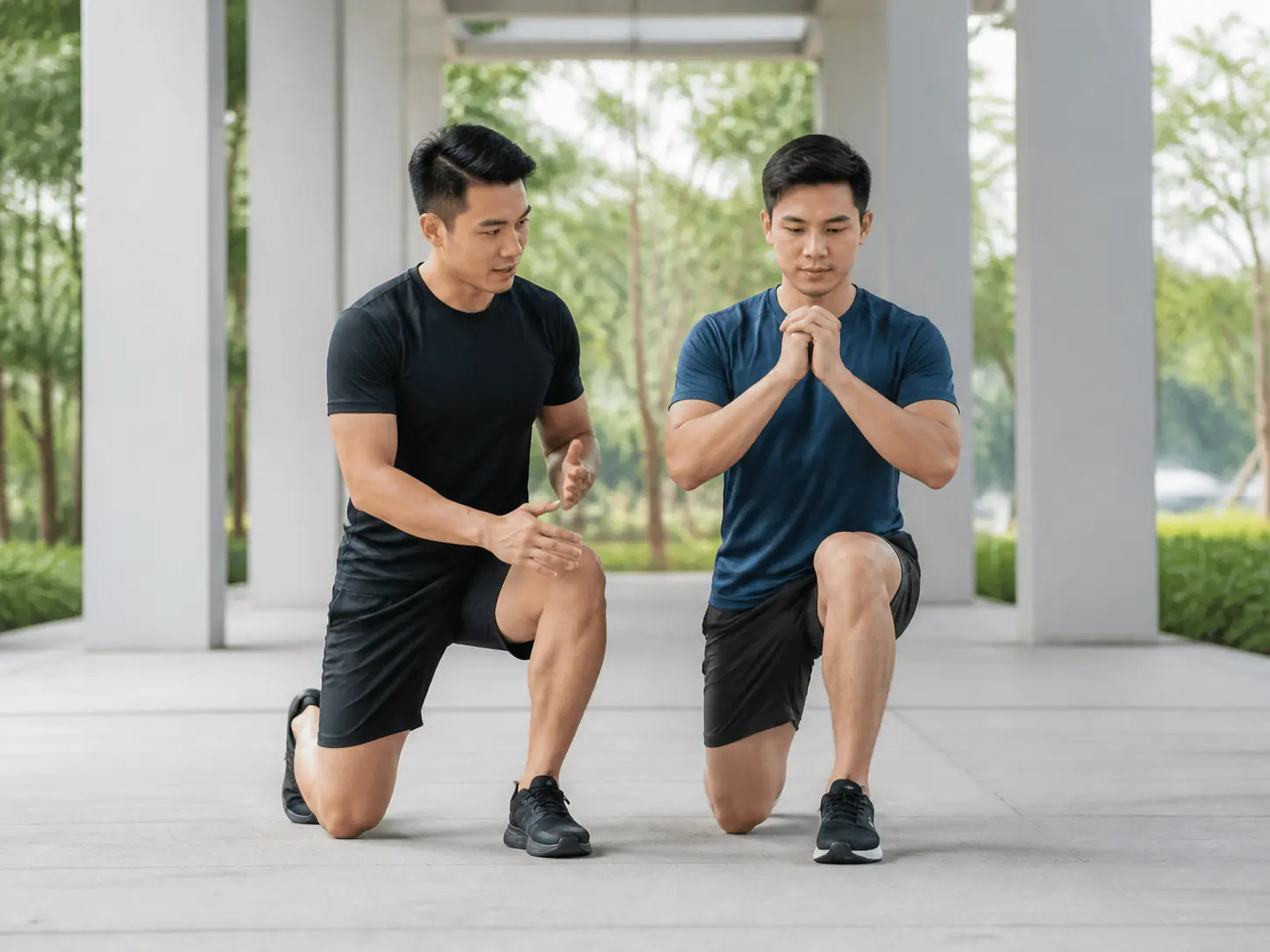
A trainer demonstrating controlled split-squat technique

For Many people training at home or without a spotter, the dumbbell chest press beats the barbell. Each arm works independently, so a stronger side cannot carry a weaker one, and you can simply drop the weights if a rep stalls.

A pair of dumbbells and a bench are enough, so it fits a condo gym or our Putra Heights centre. The extra range stretches the chest more, which many people find builds strength and shape faster.

What it trains and who it suits

It works the chest, front shoulders and triceps, with each side balancing its own load. It suits beginners, home trainers, and anyone with a strength difference between arms.

Because you can bail out safely by lowering the dumbbells, it is far friendlier to push near your limit when training alone.

Step-by-step cues

  1. Sit on a bench with a dumbbell on each thigh
  2. Lie back, guiding the dumbbells to your chest
  3. Set your shoulder blades down and back into the bench
  4. Press both dumbbells up until your arms are straight
  5. Lower with control to a deep stretch and repeat

Common mistakes and quick fixes

  • Clashing the dumbbells at the top, stop just short of touching
  • Elbows flaring wide, angle them back toward your ribs
  • Arching the back hard, keep a gentle arch, glutes on the bench
  • Dropping too fast, control the stretch to protect the shoulders

Regressions, progressions and when to stop

Too hard? Use lighter dumbbells or press from the floor for a shorter range. Too easy? Add weight, slow the lowering, or pause at the bottom. At home the floor limits range safely; at our centre we adjust bench angles too.

  • Stop if you feel sharp shoulder pain instead of working muscles
  • See a professional if a shoulder feels unstable at the bottom

Frequently Asked Questions

Dumbbell or barbell chest press?+

Dumbbells give a bigger range, even out arm strength, and are safer alone since you can drop them. The barbell allows heavier loads but needs a spotter. Both build the chest well.

How far should I lower the dumbbells?+

To a comfortable stretch, roughly level with your chest. Going deeper adds stretch but stop before your shoulders feel strained or unstable.

Can I do this without a bench?+

Yes. Press from the floor, which shortens the range as your elbows hit the ground. It is a safe way to start and still builds real strength.

Why is one arm weaker?+

Almost everyone has a stronger side, and barbells hide it. Dumbbells expose the gap and slowly even it out, which is one of their biggest advantages.

Continue exploring

Programmes

Beginner Training

Beginner training is for people starting from zero, no gym background, no idea where to begin. We keep the first weeks simple, teach you the basic movements, and build the habit before adding intensity. No crowds, no jargon, no being left to figure it out alone.

See what it includes →
Weight Loss

Build Muscle While Losing Fat

Building muscle while losing fat is possible if you get three things right: eat enough protein, train strength progressively, and keep the calorie deficit modest. It works best for beginners and returners, is slower than one goal alone, and needs measuring beyond the scale.

See the coaching approach →
Weight Loss

Weight-Loss Training for Men

Weight-loss training for men focuses on dropping the gut while keeping and building muscle, so you end up leaner and stronger rather than just lighter. We use simple strength work, honest food coaching and a plan that survives long work hours, teh tarik and weekend mamak.

See the coaching approach →
Programmes

Dumbbell-Only Programme

A dumbbell-only programme delivers a full strength and muscle-building plan using nothing but a pair of dumbbells. Ideal for home training and condo gyms with limited kit, it covers every muscle group, scales as you get stronger, and needs almost no space.

See what it includes →
Personal Training

How Often Should I Train?

For Many people, two personal training sessions a week is the sweet spot, enough to progress steadily while recovering well, with simple homework in between. The right number depends on your goal, your recovery and your schedule, which is why we set it after your assessment.

Compare this option →
Why KinesioFitness

Our Equipment & Facility

Our Putra Heights studio is private and kitted out for real strength and conditioning, barbells, dumbbells, racks, cables and space to move. Prefer to train at home or in your condo gym? We coach there too and build your plan around whatever equipment you have.

Compare this option →

Want help applying this guide to your own training?

Private coaching adapts exercise choice, loading and progression to your level, equipment and goal.

Ask a question first Request an assessment time