Skip to content
Exercise Library

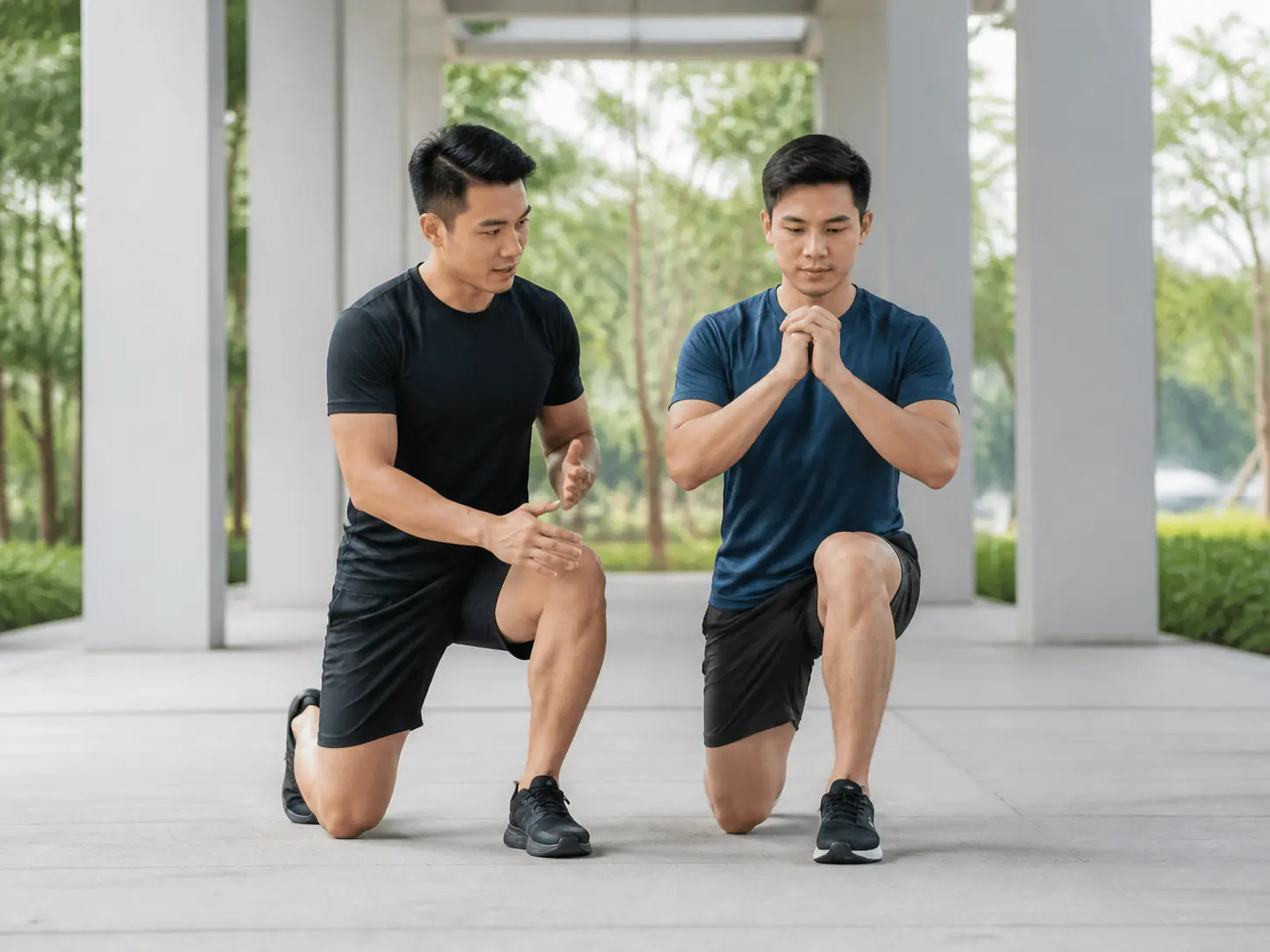
How to Do a Split Squat

In short

The split squat is a stationary lunge where your feet stay planted while you lower straight down. Training one leg at a time exposes and fixes side-to-side weakness, builds balance, and is easier on the back than heavy two-leg squats. Great for most levels.
Written & reviewed by M. Thurairaj & team, Registered Physiotherapist & Certified Trainers

Almost everyone is stronger on one leg than the other, and two-leg squats hide it. The split squat splits the work so each leg earns its strength honestly, which is why we use it with athletes and desk workers alike.

Your feet stay still, so it is more stable than a walking lunge and easier to learn. All you need is space and maybe a wall for balance, making it ideal at home or in our Putra Heights centre.

What it trains and who it suits

It loads the front-leg quad and glute while the back leg assists and stretches the hip. It suits anyone with a weaker side, runners, and people whose backs dislike heavy bilateral squats.

Because load is shared across two legs unevenly, you can build strong legs without needing huge weights, which is friendlier on joints.

Step-by-step cues

  1. Step one foot forward into a long stance, back heel lifted
  2. Keep your torso tall and weight mostly on the front foot
  3. Lower straight down until the back knee nears the floor
  4. Keep the front shin fairly vertical over the ankle
  5. Push through the front foot to return to the top

Common mistakes and quick fixes

  • Stance too short, step longer so the front knee stays over the foot
  • Leaning forward, stack your chest tall and brace the core
  • Wobbling badly, touch a wall or chair with one hand
  • Pushing off the back toe, drive up through the front heel

Regressions, progressions and when to stop

Too hard? Shorten the range or hold a support. Too easy? Add dumbbells, slow the descent, or elevate the front foot. At home a wall gives balance; at our centre we progress to rear-foot-elevated versions when you are ready.

  • Stop if you feel sharp knee or hip pain rather than muscle effort
  • See a professional if one knee consistently buckles or catches

Frequently Asked Questions

Split squat or lunge, what is the difference?+

In a split squat your feet stay planted the whole set, so it is more stable. A lunge steps in and out each rep, adding balance and coordination demands.

Which leg should I train first?+

Start with your weaker side and match those reps on the stronger side. This slowly evens out strength differences that two-leg lifts tend to mask.

My back knee hurts on the floor, help?+

Do not slam it down. Lower only to a light touch or place a folded towel as a target. Keep the movement controlled and pain-free.

How many reps per leg?+

Two or three sets of eight to twelve per leg is a solid start. Progress by adding light dumbbells before chasing very high reps.

Related pages

Exercise Library

Ankle Mobility Drill

The ankle mobility drill, often a knee-to-wall movement, improves how far your knee can travel forward over your foot. Better ankle range helps you squat deeper, lunge comfortably and protect your knees. It needs no equipment and is a quick daily win for lower-body movement.

Exercise Library

Assisted Pull-Up

The assisted pull-up uses a resistance band or machine to reduce how much bodyweight you lift, so you can practise the full pull-up movement. It bridges the gap to your first unassisted rep by letting you train the exact pattern with steadily less help.

Exercise Library

Band Pull-Apart

The band pull-apart has you stretch a resistance band across your chest by squeezing your shoulder blades. It strengthens the upper back and rear shoulders, muscles that improve posture and shoulder health. It is simple, low-risk, and perfect between other exercises.

Exercise Library

Battle Ropes

Battle ropes have you whip two heavy ropes to create waves, driving your heart rate up while working your arms, shoulders and core. They deliver intense cardio with little joint impact, are easy to scale, and are a fun way to build upper-body stamina.

Exercise Library

Bear Crawl

The bear crawl has you move on your hands and feet with your knees just off the floor. It builds full-body strength, core stability and coordination in one move, needs no equipment, and doubles as a challenging warm-up or conditioning drill for any level.

Exercise Library

Bench Press

The bench press has you lie on a bench and press a barbell from your chest. It is the benchmark for upper-body pushing strength, loading the chest, shoulders and triceps heavily. With good setup and a spotter, it is a safe and highly effective strength lift.

Ready to start?

Train at our Putra Heights centre, your home, or your condo gym

WhatsApp Book an Assessment