Skip to content

Exercise suitability guide

Exercise With Stable Osteoarthritis in KL & Selangor

If your osteoarthritis is stable and your doctor has cleared you, appropriate strength and low-impact movement can support comfortable, active daily living. We coach around your sore joints, building supporting muscle without aggravating them. We do not treat or diagnose arthritis, that stays with your doctor.
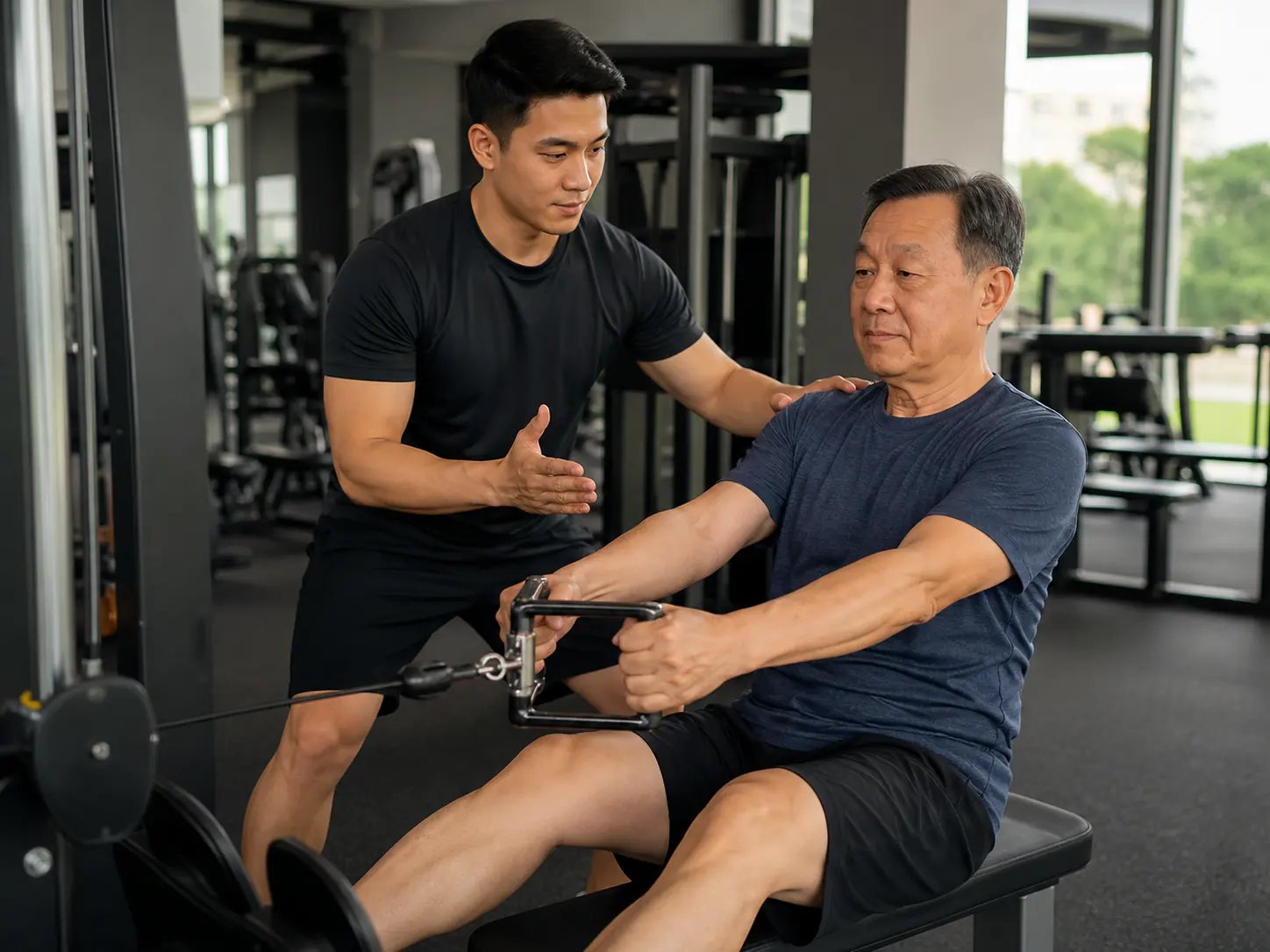
An older adult completing a supervised cable-row exercise

Stiff, achy knees or hips lead many people to move less, which often leaves the surrounding muscles weaker and daily life harder. Once your doctor has cleared you and your arthritis is stable, sensible strength and low-impact work can be a genuinely good thing, supporting the joint and helping you move through the day with more ease.

We coach movement, not medicine. We do not diagnose or treat arthritis, prescribe medication, or make claims about your joints on a scan. We build training around the joints that bother you, strengthening what supports them and choosing low-impact options, while your doctor stays in charge of the condition itself.

Working around sore joints

We build up the muscles that support your affected joints, quads and hips for knees, for example, using controlled, comfortable ranges rather than anything that grinds or flares them up. If a movement hurts in a sharp or wrong way, we swap it, because there is almost always a joint-friendly alternative.

Low-impact options do a lot of heavy lifting here. Cycling, swimming, and controlled strength work let you build fitness without the pounding that aggravates arthritic joints, and we adjust based on how you feel each day.

How we keep it joint-friendly

  • Strengthen the muscles that support your problem joints
  • Favour low-impact options, cycling, swimming, controlled strength
  • Work in comfortable ranges, avoiding painful end positions
  • Adjust the plan on stiffer, more painful days
  • Swap any movement that causes sharp or wrong-feeling pain

Red flags, get medical review

  • A sudden increase in joint pain, swelling, heat or redness
  • A joint that locks, gives way or feels unstable
  • Sharp pain during a movement, as opposed to a mild ache
  • Pain that lingers badly for days after a session
  • Anything your doctor asked you to watch for, check with them

Your doctor manages the arthritis

Diagnosing arthritis, managing flare-ups, prescribing medication, and any decisions about injections or surgery are your doctor's responsibility. We coach exercise around a stable joint and, if it flares up or changes, we ease off and refer you back rather than pushing through.

Frequently Asked Questions

Won't exercise wear my joints out faster?+

Sensible, joint-friendly exercise generally supports the joint by strengthening the muscles around it. We avoid high-impact and painful ranges. We always follow your doctor's advice and never train through a flare-up.

What if a movement hurts?+

A sharp or wrong-feeling pain means we swap that exercise, there is nearly always a joint-friendly alternative. A mild, warming ache that settles is often fine, but you set the limit and we listen.

Can you treat my arthritis?+

No. We are trainers, not medical professionals. We coach exercise around your stable condition, but diagnosing, treating and managing arthritis is entirely your doctor's job.

What about on a bad, stiff day?+

We adjust. Some days call for lighter, low-impact work or more mobility and less load. Training with arthritis means responding to how the joint feels that day, not forcing a fixed plan.

Continue exploring

Assessments

Fitness vs Clinical Assessment

A fitness assessment sets a safe starting point for training, mapping strength, stamina and movement. A clinical assessment diagnoses injuries and medical conditions, and only qualified healthcare professionals do that. We do the first, never the second, and refer you on the moment something needs a doctor or physio.

See how it works →
Assessments

Grip Strength Test

A grip strength test measures how hard you can squeeze, usually with a hand dynamometer. Grip is a surprisingly good marker of overall strength and healthy ageing. We track it as a simple, motivating fitness signal, not as a medical diagnosis, and we build it through your training over time.

See how it works →
Why KinesioFitness

Our Scope & Referral Policy

Our scope is fitness coaching: assessing movement, building strength, and guiding fat loss and conditioning for healthy or medically cleared adults. We do not diagnose, treat injuries or manage disease. When something falls outside our lane, we refer you to a doctor or physiotherapist first.

Compare this option →
Why KinesioFitness

Safety & Screening

Before you lift anything heavy, we screen you: a health-history questionnaire, a movement check, and a look at any conditions or medications that affect training. If we spot a red flag, we get you cleared by a doctor first. Good screening is why serious injuries in our sessions are so rare.

Compare this option →
Guides & Tools

Delayed Onset Muscle Soreness

DOMS is the muscle soreness that shows up a day or two after training, especially after new or harder exercise. It is normal, harmless, and fades in a few days. It is not a sign of a good or bad workout. Gentle movement, sleep and staying active help you feel better.

Read the guide →
Programmes

Low-Impact Training

Low-impact training builds strength and fitness without the jumping, pounding and jarring that bother sensitive joints. It suits heavier clients, older adults and anyone with cranky knees, hips or ankles, proving you can get genuinely fit while being kind to your body.

See what it includes →

Not sure whether exercise is suitable for your situation?

Share your situation, any medical clearance and your training goal. We will explain the fitness scope and when referral is needed.

Ask about exercise suitability Request an assessment time