Your first step
The Push-Up Test: Upper-Body Strength Check
A push-up test counts how many good-form push-ups you can do in a row to gauge upper-body strength and endurance. We scale it, wall, incline, knees or full, to your level. It is a fitness marker we improve over time, done with quality reps, not a max-out competition or a medical test.
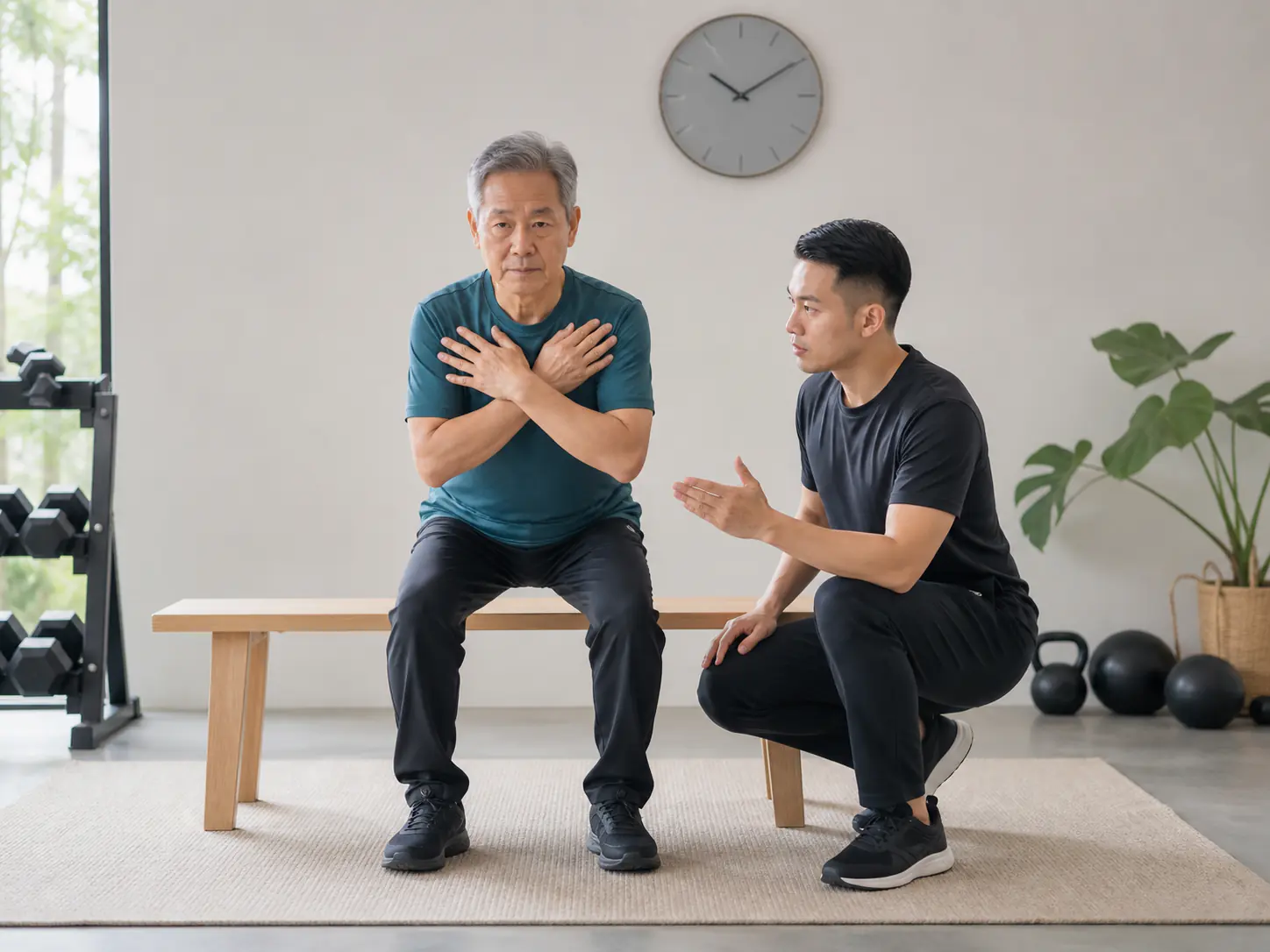
The push-up is a brilliant test because it needs no equipment and scales to almost anyone. The push-up test simply counts how many clean, controlled reps you can do before form breaks down, giving us a clear read on upper-body strength and endurance. Crucially, form leads, a wobbly, half-range push-up does not count.
Most beginners cannot do a full floor push-up at first, and that is completely fine. We scale it to where you are, pushing off a wall, a bench, or from the knees, so everyone gets a fair, honest number to build from. As you get stronger, we progress the variation, and watching that happen is genuinely satisfying.
What the push-up test shows
It measures the strength and endurance of your chest, shoulders, arms and the core that holds you rigid. Because it uses your own bodyweight, it reflects strength that transfers straight into real life, pushing, carrying, catching yourself if you trip.
We count only reps done with good form through a full range. Twenty sloppy half-reps tell us less than eight clean ones, so quality always sets the score.
Scaling it to your level
- Wall push-ups for complete beginners
- Incline push-ups off a bench or sturdy surface
- Knee push-ups as a middle step
- Full floor push-ups once strength allows
- We pick the version where your form stays clean
How to do the push-up test
- We choose the push-up variation that matches your strength
- You perform reps with a straight body and full range
- We count only clean reps, form beats quantity
- We stop when technique starts to break down
- We record the number and variation to track progress
Keeping it safe
We warm the shoulders first and stop if you feel joint pain rather than muscle effort. If a shoulder or wrist hurts sharply, that is a note to adjust the variation or, if it persists, get it checked. The test measures fitness, it is never worth grinding through pain for a higher number.