Skip to content

Exercise suitability guide

Exercise With Osteoporosis After Clearance in KL & Selangor

With osteoporosis, exercise must be approached carefully and only after clear medical clearance. We coach controlled strength and balance work, avoid high-risk movements like heavy spinal bending or twisting, and follow your doctor's restrictions exactly. We never treat osteoporosis or interpret your scans.
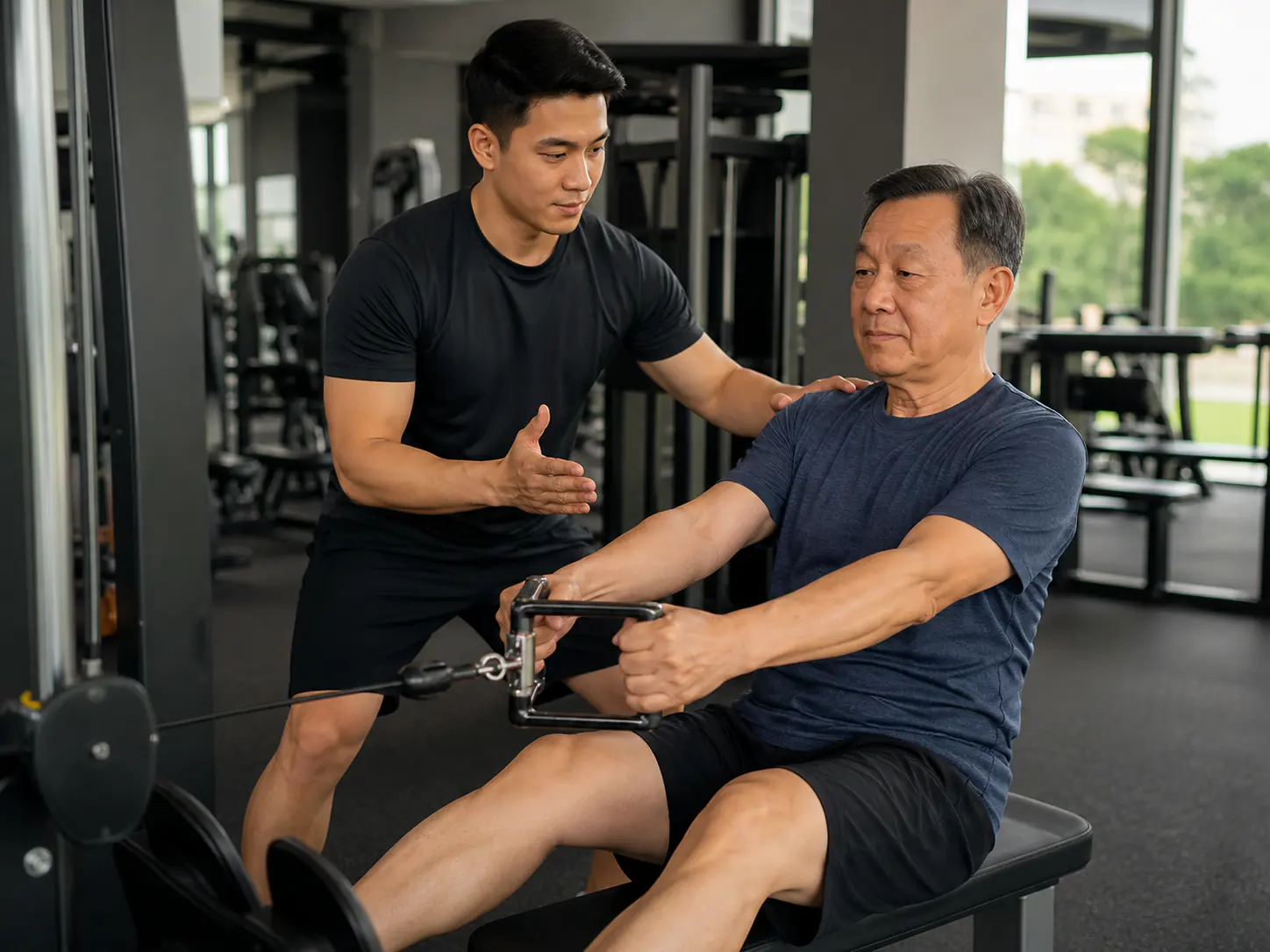
An older adult completing a supervised cable-row exercise

Osteoporosis needs more caution than low bone density, and clearance from your doctor is non-negotiable before we start. With that in place, careful exercise still has real value, building strength and, importantly, working on balance so you feel steadier and more confident on your feet in daily life around KL.

This is coaching, not medical care. We do not treat osteoporosis, prescribe medication, or interpret your bone scans, and we never promise to change your bone density. Our whole focus is training safely inside the limits your doctor set, avoiding the movements that carry risk and building the ones that build confidence.

Training with real care

We keep everything controlled and well-supported, and we steer firmly clear of higher-risk movements, heavy forward bending of the spine, sudden twisting, and anything jarring or high-impact. Load is added slowly and only with clean technique, because with osteoporosis, patience is the safest approach.

Balance work carries extra weight here. A large part of staying well with osteoporosis is staying steady on your feet, so we build that into every plan alongside gentle, controlled strength work.

Movements we avoid unless your doctor says otherwise

  • Heavy or repeated forward bending of the spine
  • Sudden or loaded twisting of the trunk
  • High-impact activities like jumping or jarring landings
  • Any exercise your doctor specifically told you to avoid
  • Rapid load increases, everything progresses slowly

Red flags, stop and get review

  • New, sudden or worsening back pain
  • Back pain with loss of height or an increasingly stooped posture
  • Any pain after a fall, knock or awkward movement, get checked
  • Sharp bone pain during or after a session
  • Anything your doctor flagged, stop and contact them promptly

Your doctor stays firmly in charge

Osteoporosis is a medical condition your doctor diagnoses, monitors and treats, often with medication. We never touch that. We train strictly within the limits they set, and if you have a fall, new pain, or any concern, we stop and send you straight back to them before continuing.

Background guidance

This page is written to align with the general public-health guidance below. These sources do not endorse KinesioFitness, and this page is not medical advice.

How we create and check content →

Frequently Asked Questions

Is it safe to exercise with osteoporosis?+

Only with clear medical clearance and careful coaching. We use controlled strength and balance work and avoid high-risk movements. We follow every restriction your doctor set, clearance is essential before we begin.

What movements are off-limits?+

Generally heavy spinal bending, loaded twisting, and high-impact moves, plus anything your doctor named. We favour controlled, supported exercises and progress load very slowly.

Can exercise reverse osteoporosis?+

We make no such claim, that is entirely for your doctor to manage and assess. Careful exercise supports strength, balance and confidence in daily life, which is valuable in its own right.

Why so much focus on balance?+

Staying steady on your feet is a big part of living well with osteoporosis. We build balance and coordination into every session so you feel more confident moving around day to day.

Continue exploring

Assessments

Pre-Exercise Screening

Pre-exercise screening is a structured conversation and questionnaire used before training to understand relevant health history, medications, symptoms, previous injuries and recent activity. It informs the fitness starting point and whether medical or clinical clearance should come first.

See how it works →
Assessments

Fitness vs Clinical Assessment

A fitness assessment sets a safe starting point for training, mapping strength, stamina and movement. A clinical assessment diagnoses injuries and medical conditions, and only qualified healthcare professionals do that. We do the first, never the second, and refer you on the moment something needs a doctor or physio.

See how it works →
Health & Exercise

Returning to Exercise After Hospitalisation

After a hospital stay, returning to exercise needs clear medical clearance and a very gentle start. With your doctor's go-ahead, we rebuild strength and stamina step by step, following any limits they set. This is coaching, not rehabilitation or medical care, we work alongside your medical team, never instead of them.

Read the suitability guide →
Who We Help

Postnatal Personal Training for New Mothers

After your doctor clears you to exercise post-birth, rebuilding needs to be gradual and gentle, especially around the core. Postnatal training starts with reconnecting your deep core and progresses slowly to full strength, at home so you can fit it around a newborn. Only after medical clearance.

See how coaching adapts →
Women’s Fitness

Menopause & Bone Health

Bone health training uses weight-bearing and resistance exercise to help keep bones strong as oestrogen falls. We coach women one-to-one with safe, progressive loading. We do not diagnose or treat osteoporosis, for scans, diagnosis and medication, your doctor leads and we train alongside their advice.

See how coaching adapts →
Guides & Tools

Bone Density And Exercise

Bones respond to being loaded, so strength training and weight-bearing exercise help build and maintain bone density. This becomes especially valuable with age, as bones naturally weaken. Loading your bones sensibly through resistance and impact supports lifelong bone health. For medical concerns, see a doctor.

Read the guide →

Not sure whether exercise is suitable for your situation?

Share your situation, any medical clearance and your training goal. We will explain the fitness scope and when referral is needed.

Ask about exercise suitability Request an assessment time